Flexible Skins for Morphing Aircraft: Miura-Ori Origami Structures with Negative Poisson's Ratio
5-person team mentored by Prof. Norman Wereley, UMD Aerospace
Abstract
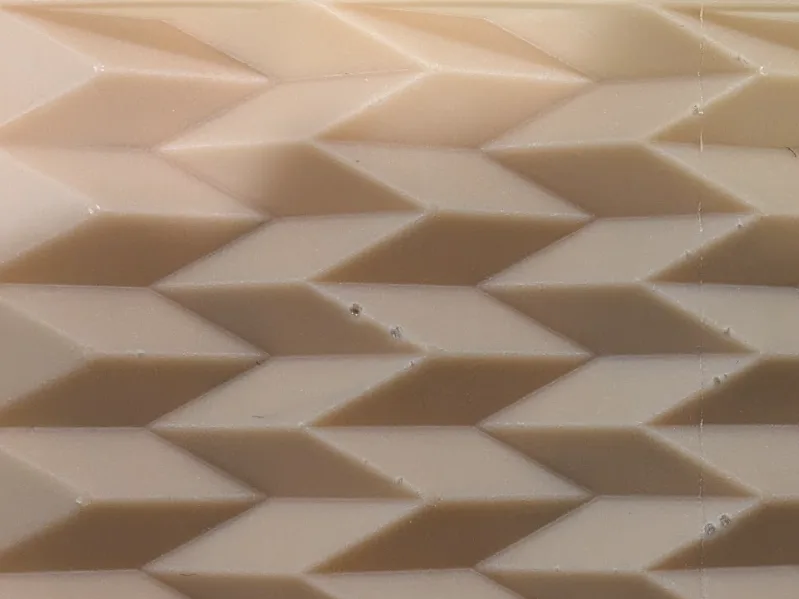
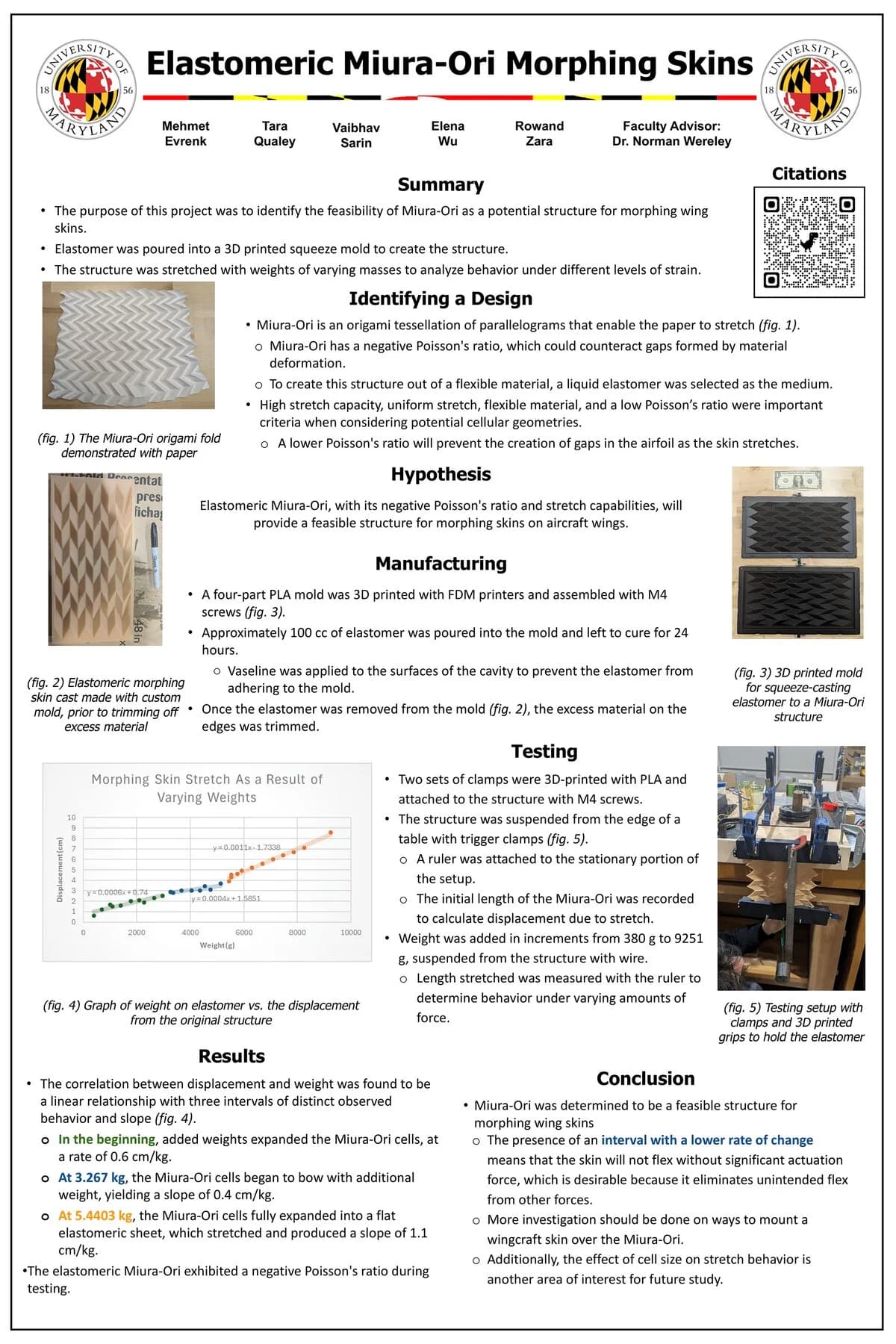
Morphing aircraft wings need skins that deform smoothly with the structure without buckling, tearing, or morphing unintentionally under aerodynamic loads. This work evaluates Miura-ori origami structures — which exhibit a negative Poisson's ratio and elastomeric behavior — as candidate flexible skins. TPU specimens were cast in a custom 4-part PLA squeeze mold and tested under incremental loading, yielding deformation slopes of 0.4–1.1 cm/kg. The low displacement-per-weight rate of change implies a loading interval requiring substantial actuation force, meaning the skin resists unintended morphing from outside forces — supporting Miura-ori structures as a feasible candidate for morphing wing applications.
1.Objectives
- 1.1Evaluate candidate structures — herringbone lattice, honeycomb, and origami patterns — as flexible skins for morphing wings
- 1.2Develop a repeatable fabrication method within a $50 budget and a TPU material constraint
- 1.3Characterize load-deformation behavior under incremental loading
2.Methodology
After a structures trade study, the Miura-ori pattern was selected for its negative Poisson's ratio and simple reproducibility. TPU specimens were cast in a custom squeeze mold, cured for 24 hours, and loaded with incremental weights; deformation was recorded across the load sweep and processed in MATLAB.
3.Experimental setup
A 4-part PLA squeeze mold and custom test fixtures, designed in SolidWorks and fabricated on UMD's FDM and multi-material printers, enabled repeatable casting and consistent specimen geometry.
4.Data collection
Deformation measurements across incremental-weight load steps for each cast specimen.
5.Analysis
MATLAB processing of load-deformation data; slope extraction across the loading range to characterize compliance and identify the high-actuation-force interval.
6.Results
- ✓Measured deformation slopes of 0.4–1.1 cm/kg across specimens.
- ✓Confirmed negative Poisson's ratio behavior in the Miura-ori geometry under load.
- ✓Identified a loading interval requiring immense actuation force — the skin resists unintended morphing from external aerodynamic forces.
7.Conclusions
Miura-ori TPU structures deform predictably, exploit negative-Poisson's-ratio behavior, and resist unintended deformation — exactly the combination a morphing skin requires. The structure is a feasible candidate for morphing aircraft wing applications.
8.Future work
- Cyclic and fatigue testing of cast specimens
- Characterization of directional (anisotropic) stiffness
- Integration study on a representative wing section